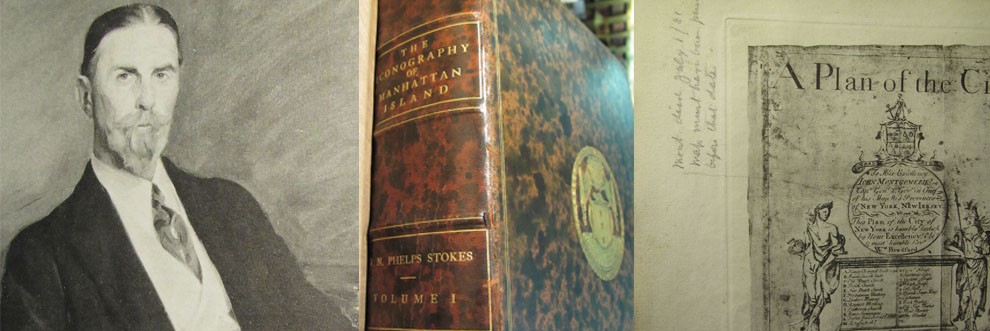
Stokes, I. N. Phelps.
The Iconography of Manhattan Island, 1498–1909, Compiled from Original Sources and Illustrated by Photo-intaglio Reproductions of Important Maps, Plans, Views and Documents in Public and Private Collections.
6 vols.
New York: R. H. Dodd, 1915–1928.
Contemporary sprinkled calf with gilt fillet frame and rosettes at corners on cover, spine gilt in compartments; gold-stamped insignia of New Amsterdam on front and of New York on back cover. NYPL copy on vellum; BML copy printed on handmade paper.*
Volume I: New York Public Library: Archives | Manuscripts | Rare Books
Volumes II–VI: Brooklyn Museum Library
Completed in 1928, The Iconography of Manhattan Island remains, as architect Norval White (1926–2009) once declared, “the most exhaustive record of a built place ever attempted, let alone fulfilled.”4
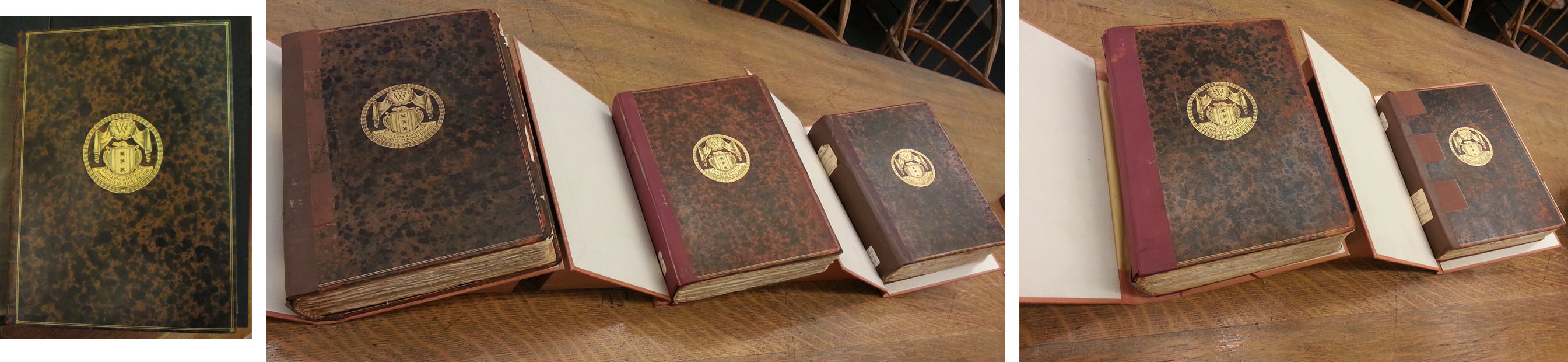
Fig. 11. (L-R): Iconography of Manhattan Island Volumes I-VI.
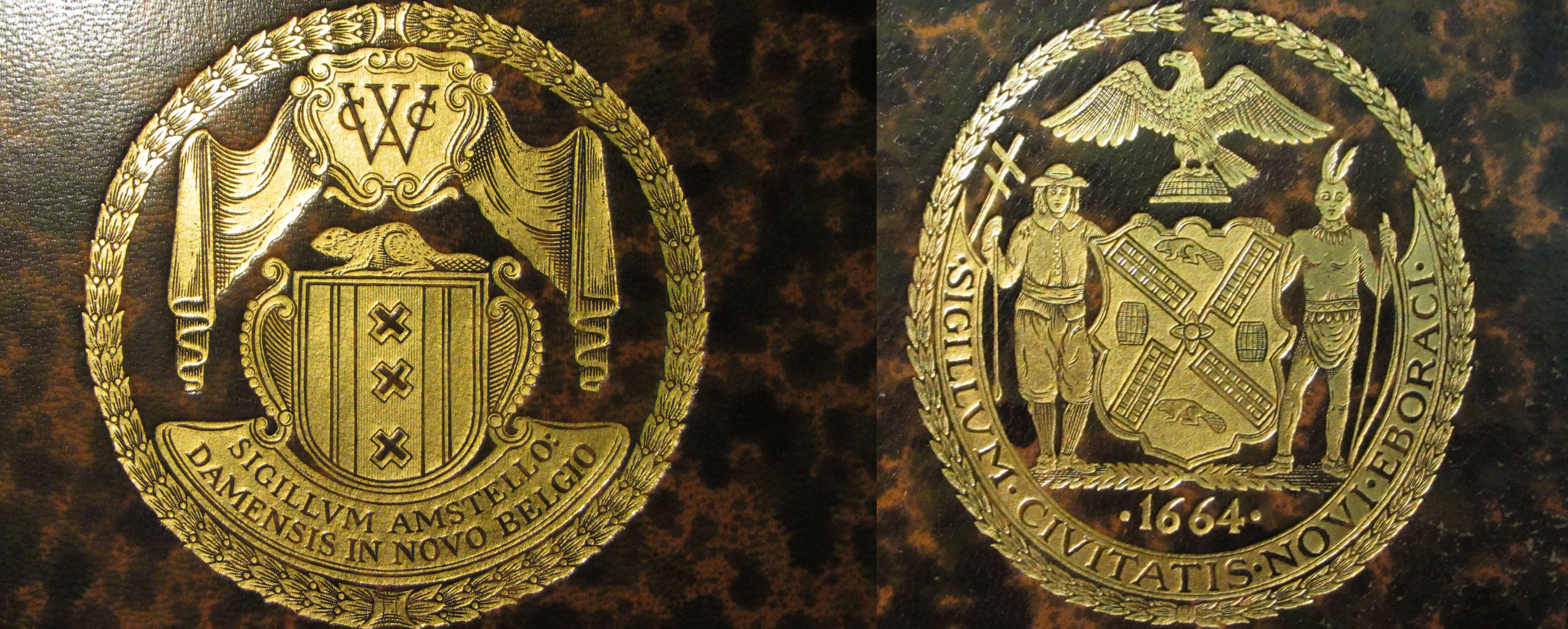
Fig. 12. Detail, Volume I: gilt-stamped emblems of New Amsterdam (L) and New York (R).
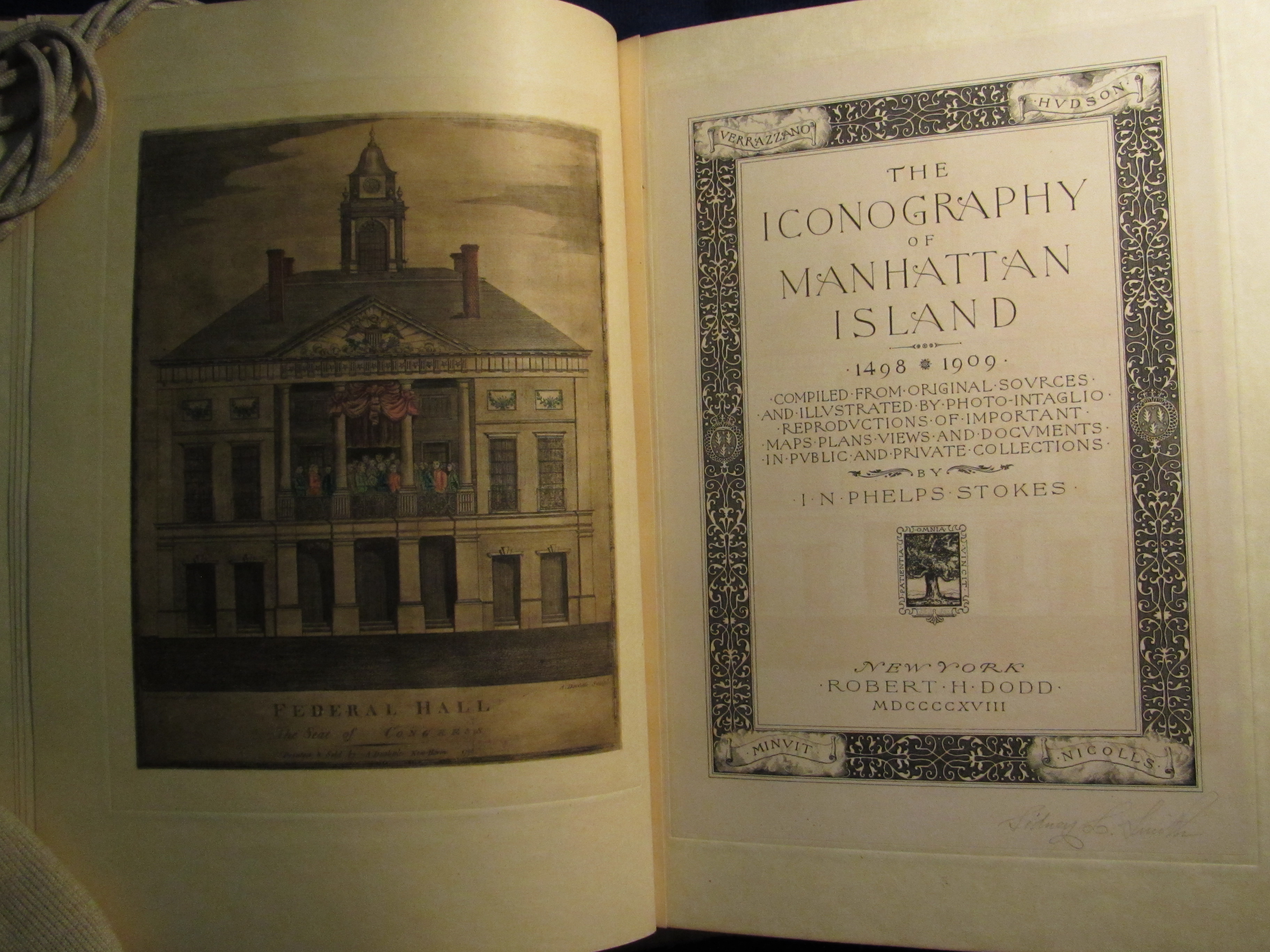
Fig. 13. Frontispiece, Volume I:
Color reproduction, “Federal Hall,
the seat of Congress and the inauguration of George Washington…”
(The only known contemporary view of the
inauguration, one of six impressions, 1789.)

Fig. 14. Foldout plate, Iconography of Manhattan Island: Bridges Map, the Commissioners’
Grid Plan of 1811.
(Original in NYPL Eno Collection.)
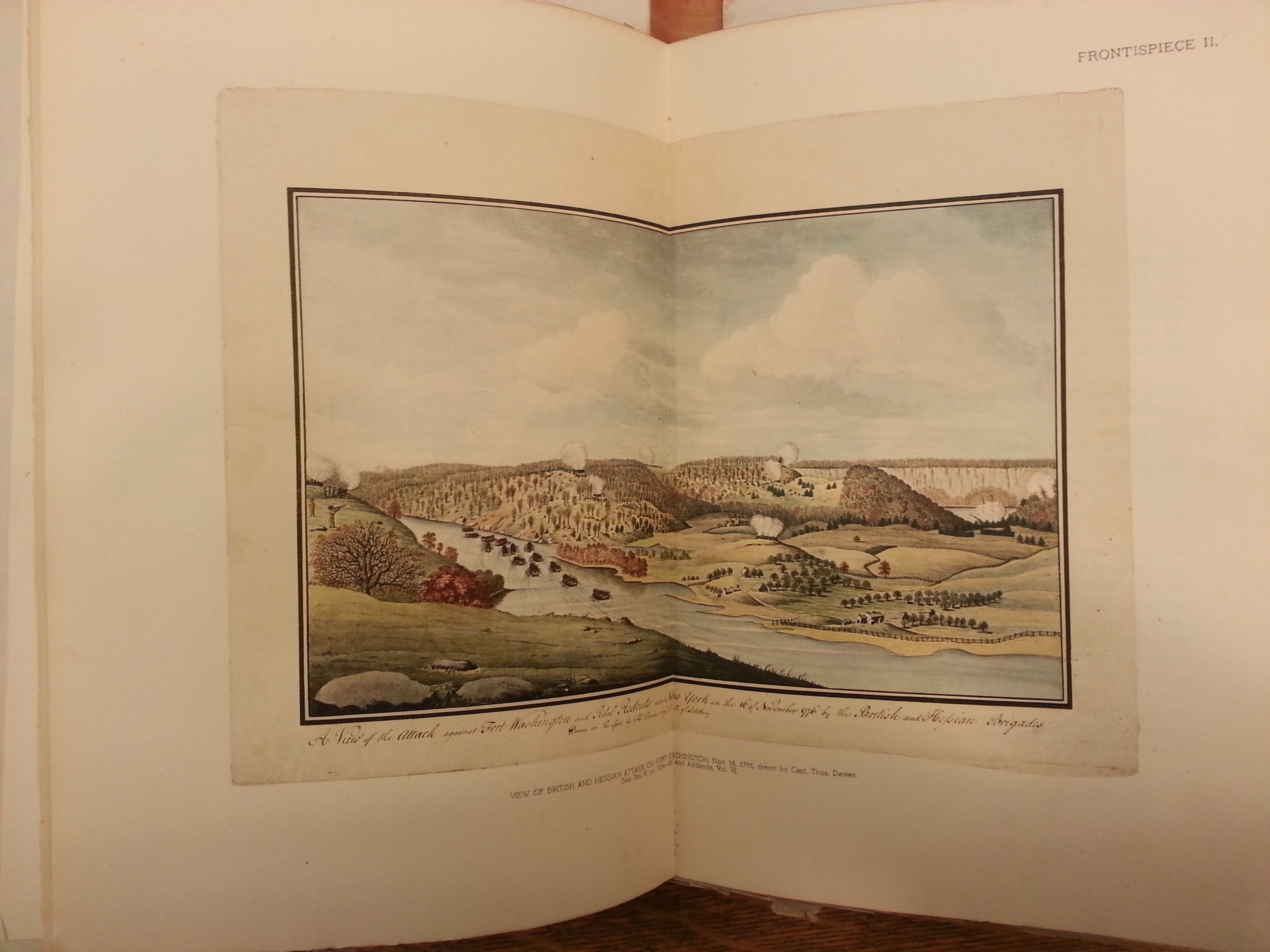
Fig. 15. Frontispiece II, Volume VI:
“View of British and Hessian Attack
on Fort Washington, Nov. 16, 1776;
Drawn by Capt. Thos. Davies.”
Four hundred two copies,5 total, were made of the first edition set of Iconography.6 The New York Public Library copy, one of forty-two on vellum, bears Stokes’ handwritten dedication.
The series is ubiquitous—over 450 sets of copies worldwide7, mostly found in reference collections—something that speaks to its indispensability. It is also, consequently, sometimes benignly neglected as a rare book: its reputation as an encyclopedic resource has often belied its value as a physical object, and overuse of first edition copies in some libraries has resulted in damaged bindings, and worse.
The volumes are dedicated, separately, to past and future “happy sojourners on Manhattan Island,” James Lenox, Henry Harrisse, and William Gillis. Volumes I–V present the reader with topographical material (prints and maps) and corresponding essays written by Stokes, an annotated list of “all known maps—including those thought to be lost—of Manhattan through the seventeenth century,” a “Check-List” of “Early New York Newspapers (1725–1811),” and unparalleled social history chronologies. Volume VI is a New York City researcher’s dream: Stokes’ annotated bibliography.
Again, Morrone puts it best: “Iconography is a different form of historical work altogether: an expert gathering and sifting of primary materials whose like we will never see again.”
*BML copy repaired with 20th-century interventions.
4White would’ve known, presumably: he spent forty-two years revising and updating The AIA Guide to New York City, and died before the most recent edition was complete.
5Not including copies made for “distribution to foreign libraries,” as indicated in the preliminaries of Volume VI.
6A total of 2,412 books, then, comprised the entire first-edition run of the series.
7Including subsequent editions, digital surrogates, and microfilm copies.
 Manhattan's Icon