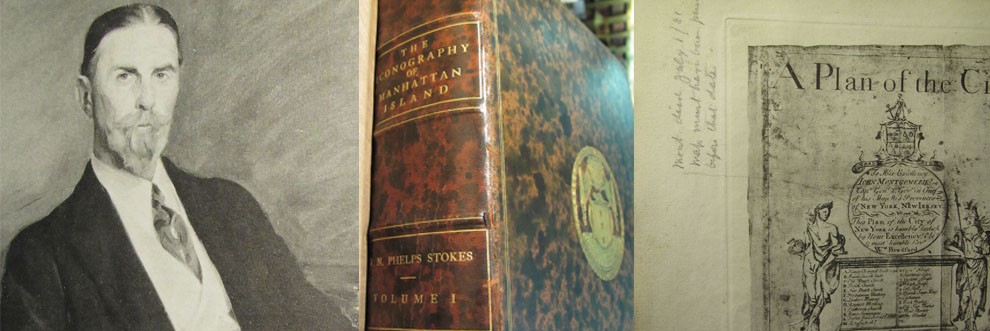
As they lined up to leave, coats on and backpacks once again in their rightful places, I asked the students if anyone wanted to share one thing they had learned in our half hour together, when we had uncovered local history through a small exhibition at the Brooklyn Historical Society. A boy, Tecumseh,* raised his hand and offered, “I learned that there was a man named Isaac Newton Phelps Stokes, and we have old maps because of him.”
It was not exactly what those fifth-grade students were sent there to learn that day, but it was something, the kind of thing that warms a certain kind of girl’s heart.
This project began in March 2015, but the genesis of an interest in Stokes came much earlier. In school for historic preservation, students are inundated with polysyllabic proper names of men of distinction: Andrea Palladio, Inigo Jones, Alexander Jackson Davis, Andrew Jackson Downing, Richard Morris Hunt, Benjamin Henry Latrobe. I. N. Phelps Stokes was one of those names, floating in and out of discussions, parenthetically mentioned in lectures, hovering, another dead white guy who designed beautiful things.
And so Stokes repeatedly surfaced in my life: from leading tours on the Lower East Side past University Settlement House (1898), to rediscovering St. Paul’s Chapel at Columbia, to his late work regarding the 1939 World’s Fair, to the Sargent portrait at the Met and the realization that “the house”—the Branch Bank of the United States, entrance to the American Wing period rooms and galleries—was there thanks to his intervention, to the maps, always the maps….
Selecting Stokes as a subject came with challenges: a successful, yet obscure figure, it was unclear, at times, if finding reference and biographical material was even possible. In consideration of time constraints and collection limitations, the project necessarily acquired a narrow focus, and tying all the items together under the theme, “Iconography: its production and impact” was a demanding, self-imposed task. Fortunately, my work and school scheduling in early April was flexible enough to allow for repeat extended visits to the cited collections.
The most difficult aspects were, perhaps, the less-visible parts of this project. Editing copy for the site’s pages took weeks of revision (super-revisionist Stokes probably would’ve approved), selecting single objects for the exhibition meant a process of elimination (something at which I obviously failed), and choosing a WordPress template was a somewhat time-consuming experimental adventure. But, all that is not to mention the most arguably unnecessary element of this project, also something for which I hold a modicum of pride: I modified this entire site—from including Alt tags on everything all the way down to the font type, sizes, and coding (coding!) for italicized and linked content—a kind of design trial of my own devising, but something that nonetheless seemed appropriate, given my subject. A grand experience, indeed.
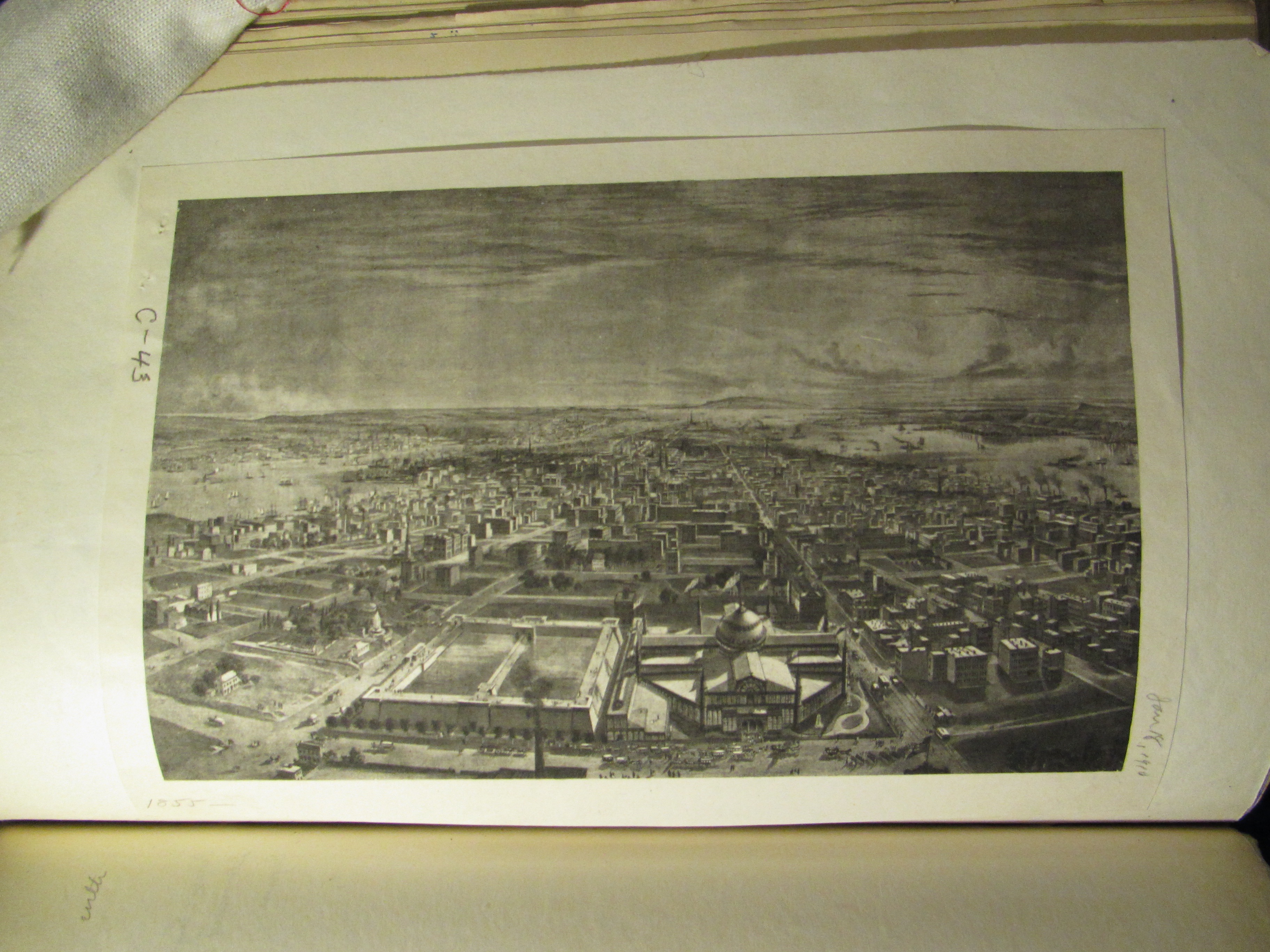
Photoreproduction of engraving,
“New York from the Latting Observatory,” 1855.
View of New York looking south, showing the Crystal Palace and Croton Reservoir (foreground, center), now Bryant Park and
the New York Public Library.
*Real name. You can’t make this stuff up.
 Manhattan's Icon